
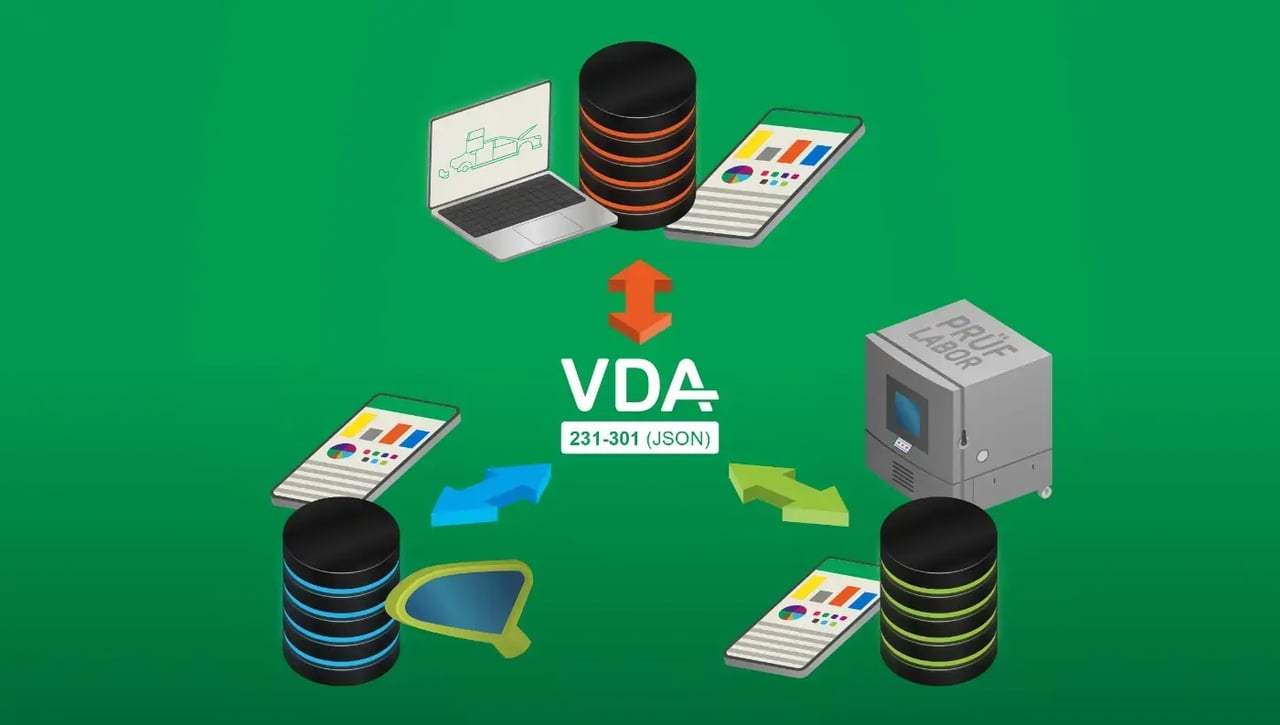
How the VDA 231-301 Recommendation Standardises Machine-Readable Test Data Interfaces – and Why Brain of Materials Is the Implementation Partner of Choice for OEMs, Tier Suppliers, and Material Manufacturers
What Is VDA 231-301? – Definition, Scope, and Purpose
VDA 231-301 is a recommendation published by the German Association of the Automotive Industry (Verband der Automobilindustrie, VDA) that defines a standardised, machine-readable data model for the digital exchange of test results in material sampling processes. It was developed collaboratively by leading automotive OEMs, Tier suppliers, testing laboratories, system providers, and the Institute for Engineering Design and Industrial Design (IKTD) at the University of Stuttgart.
The core objective of VDA 231-301 is to replace fragmented, document-based data exchanges – such as PDF data sheets, proprietary Excel templates, and unstructured email attachments – with a single, semantically clear interface format. By establishing a common data structure based on JSON schemas, VDA 231-301 enables cross-system processing of testing requirements, testing conditions, and result structures without interpretative ambiguities.
In practical terms, VDA 231-301 provides:
- A generic, extensible data model for describing material test results and associated metadata
- Structured references to norms, standards, and OEM-specific specifications
- A JSON-schema-based interface format that supports automated validation and system
integration - An open-source GitHub repository for community-driven development and versioning of sub-schemas
- A clear semantic foundation that eliminates coordination overhead caused by inconsistent
data interpretations
Why VDA 231-301 Matters for the Automotive Supply Chain
The digitalisation of materials quality assurance has long been hindered by heterogeneous data formats and processes characterised by media discontinuities. In a typical scenario, an OEM defines testing requirements in a specification document, a Tier supplier interprets these requirements and commissions a laboratory, and the laboratory returns results in yet another format. Each handover introduces the risk of misinterpretation, data loss, and manual rework.
The consequences of this fragmentation are significant:
- Increased coordination efforts between OEMs, suppliers, and testing laboratories
- Delays in sampling, approval, and PPAP processes
- Redundant data collection across multiple projects and stakeholders
- Limited automation capabilities in CAQ, PLM, and ERP systems
- Reduced scalability for organisations managing multi-material, multi-supplier test
programmes - Elevated process costs and longer time-to-market cycles
VDA 231-301 addresses these challenges directly by providing a standardised interface that all stakeholders in the value chain can implement. When testing requirements, conditions, and results are exchanged in a consistent, machine-readable format, validation can be automated, integration into downstream systems becomes seamless, and audit-proof documentation is ensured by design.
Key Technical Components of VDA 231-301
Understanding the technical architecture of VDA 231-301 is essential for organisations planning their implementation. The standard is built on several foundational components that work together to create a robust, interoperable data exchange framework.
JSON Schema as the Data Exchange Format
VDA 231-301 uses JSON (JavaScript Object Notation) schemas to define the structure of test data exchanges. JSON was chosen for its widespread adoption in modern IT systems, its
human-readability, and its native support for automated validation. The schemas are publicly available on the official VDA 231-301 GitHub repository, enabling transparent versioning, community contributions, and collaborative development.
Each JSON schema within VDA 231-301 defines mandatory and optional fields, data types, and structural relationships. Sub-schemas exist for specific test standards – for example, VDA 275, VDA 278, VDA 270, SEP 1240, and EN 10204 – allowing organisations to implement only the portions relevant to their testing programmes while maintaining full compatibility with the overarching data model.
BusinessKeys and the TestID (TID) as Unique Identifiers
Within the VDA 231-301 framework, so-called BusinessKeys can be employed to enhance the data model with unique identifiers. The TestID (TID), developed and maintained by Brain of Materials, serves as a particularly powerful BusinessKey. Each TestID provides a unique, machine-readable reference to a concretely defined testing methodology, including its parameterisation, conditions, and specification references.
The TestID resolves a persistent challenge in materials quality assurance: normative texts and OEM specifications frequently contain formulations that leave room for interpretation. A testing requirement described as "tensile test according to ISO 527 at room temperature" may be understood differently by different stakeholders regarding specimen geometry, strain rate, conditioning time, or acceptance criteria. The TestID eliminates this ambiguity by encoding every relevant parameter into a single, unambiguous identifier.
Within VDA 231-301, the TestID functions as a BusinessKey that bridges the gap between
normative text and operational testing practice – ensuring that all parties share an identical
understanding of what is to be tested, under which conditions, and according to which specification.
Relationship to VDA 231-300 and DIN SPEC 91383
VDA 231-301 is designed to complement VDA 231-300, which standardises the embedding of
material and surface requirements in 3D CAD data sets. Together, these two recommendations create a continuous digital data chain: VDA 231-300 ensures that requirements are communicated unambiguously at the design stage, while VDA 231-301 ensures that the corresponding test results are exchanged in a structured, validated format.
Both standards are aligned with DIN SPEC 91383, which provides the foundation for standardised material and surface information exchange in the CAD-neutral JT format. This alignment ensures that organisations implementing VDA 231-301 can integrate seamlessly with existing digital infrastructure built around these complementary standards.
Who Benefits from Implementing VDA 231-301?
VDA 231-301 is relevant for every stakeholder in the materials quality assurance value chain. While the standard was developed within the automotive industry, its generic data model makes it applicable to any domain where structured, quality-assured test data exchange is required.
Automotive OEMs
For OEMs such as Mercedes-Benz, BMW Group, and Volkswagen – all of whom contributed to the development of VDA 231-301 – the standard enables automated validation of incoming test results against defined acceptance criteria. This reduces manual review effort, accelerates approval timelines, and provides a consistent, audit-proof data basis for regulatory compliance and internal quality management.
Tier 1 and Tier 2 Suppliers
Suppliers benefit from reduced coordination overhead when communicating test results to multiple OEMs. Instead of maintaining separate, customer-specific reporting formats, suppliers can adopt a single standardised interface that satisfies the requirements of all downstream partners. VDA 231-301 also simplifies cross-project benchmarking and enables suppliers to build comprehensive requirement plans that consolidate historical and current test data.
Material Manufacturers and Compounders
Material manufacturers face particularly complex testing programmes, often involving dozens of individual tests per material grade across multiple OEM specifications. VDA 231-301 enables these organisations to structure their test data once and exchange it consistently with all customers, eliminating redundant data collection and reducing the administrative burden associated with multi-customer material approvals.
Testing Laboratories and Service Providers
Accredited testing laboratories benefit from receiving unambiguously defined testing requirements and returning results in a structured format that integrates directly into their clients' systems. This reduces iterative clarification cycles, minimises the risk of misinterpreted requirements, and enables laboratories to operate more efficiently at scale.
Implementing VDA 231-301 with Brain of Materials
Brain of Materials is a platform for structured material data exchange that actively participates in the development of VDA 231-301 and integrates practical experience from OEM, Tier supplier, and material manufacturer projects into the standardisation process. As an implementation partner, Brain of Materials provides the operational infrastructure required to translate the VDA 231-301 data model into day-to-day practice.
Direct Utilisation of VDA 231-301 Data Models
The Brain of Materials platform enables direct utilisation of VDA 231-301 data models and their integration into existing system landscapes. Organisations can configure test plans, exchange test results, and validate incoming data against defined specifications – all within a single, centralised environment that eliminates media discontinuities.
TestID Assignment and Retrospective Structuring
A significant practical challenge in adopting VDA 231-301 lies in the conversion of existing legacy data – historical test results stored in PDF data sheets, Excel files, or proprietary formats – into the standardised data model. Brain of Materials addresses this challenge through a hybrid methodology that combines AI-based extraction, algorithmic mapping, and domain-expert validation.
This approach enables organisations to:
- Upload existing data sheets and automatically detect testing requirements
- Receive AI-generated suggestions for appropriate TestID assignments
- Validate automated suggestions through continuous feedback loops with subject matter experts
- Transform legacy document repositories into a consistent, interoperable data source
- Achieve cost-effective standardisation even for large legacy data inventories
Integrated Laboratory Commissioning
Brain of Materials provides direct access to a network of over 50 accredited testing laboratories through a single platform. Once a test plan has been configured using TestIDs, laboratories can be selected and commissioned directly – eliminating separate procurement workflows, fragmented email coordination, and ambiguous PDF attachments. Test results are automatically fed back into the platform, mapped to the corresponding TestIDs, and immediately available for evaluation, benchmarking, and system integration.
This integrated approach transforms what has traditionally been a coordination-intensive process lasting weeks into a streamlined digital workflow that can be completed in minutes.
How to Get Started with VDA 231-301: A Practical Roadmap
Organisations considering the adoption of VDA 231-301 can follow a structured implementation approach to maximise efficiency and minimise disruption to existing workflows.
-
Assess Current Data Landscape: Inventory existing test data formats, identify pain points in current exchange processes, and evaluate the volume of legacy data requiring conversion.
-
Define Integration Requirements: Determine which downstream systems – CAQ, PLM, ERP – need to receive structured test data, and map the required data flows.
-
Select Relevant Sub-Schemas: Identify which VDA 231-301 sub-schemas apply to your testing programme (e.g., VDA 275, VDA 278, EN 10204) and review the corresponding JSON schemas available on the official GitHub repository.
- Implement TestID Framework: Assign unique TestIDs to all testing requirements to ensure unambiguous identification and machine-readable referencing across your supply chain.
- Convert Legacy Data: Use a structured methodology – ideally combining automated extraction with expert validation – to transform historical test data into the VDA 231-301 data model.
- Integrate and Validate: Connect the standardised data interface to your existing systems, establish automated validation rules, and verify end-to-end data flow from test commissioning through to result evaluation.
-
Scale Across the Supply Chain: Extend the standardised interface to suppliers, laboratories, and OEM partners, establishing a fully digital, interoperable data chain.
Key Benefits of VDA 231-301 Adoption
Organisations that adopt VDA 231-301 early position themselves for measurable improvements across their materials quality assurance processes:
- Reduced Process Costs: Elimination of manual data transfers, redundant data collection, and iterative clarification cycles
- Accelerated Approvals: Automated validation of test results against defined acceptance criteria shortens sampling and release timelines
- Enhanced Data Quality: Standardised, semantically clear data structures reduce errors and improve consistency across projects and suppliers
- Increased Scalability: A single, interoperable data interface replaces customer-specific
reporting formats, enabling efficient multi-OEM operations - Audit-Proof Documentation: A continuous digital data chain from test commissioning
through to result evaluation satisfies regulatory and quality management requirements - Future-Proof Infrastructure: Alignment with VDA 231-300, DIN SPEC 91383, and
open-source JSON schemas ensures long-term interoperability and adaptability
Frequently Asked Questions About VDA 231-301
What is the difference between VDA 231-300 and VDA 231-301?
VDA 231-300 defines how material and surface requirements are embedded in 3D CAD data sets using the JT format. VDA 231-301 complements this by defining a standardised format for the digital exchange of actual test results. Together, they form a continuous digital data chain from requirement definition through to result evaluation.
Is VDA 231-301 mandatory for automotive suppliers?
VDA 231-301 is a recommendation, not a mandatory regulation. However, as OEMs increasingly require structured, digital test data exchanges, adoption is becoming a practical necessity for suppliers seeking to remain competitive and meet customer requirements efficiently.
What is a TestID, and how does it relate to VDA 231-301?
A TestID (TID) is a unique, machine-readable identifier that precisely defines a testing requirement, including its methodology, parameterisation, and conditions. Within VDA 231-301, the TestID functions as a BusinessKey that enhances the data model with unambiguous references, eliminating interpretative leeway in testing requirements.
Can VDA 231-301 be used outside the automotive industry?
Yes. While VDA 231-301 was developed within the automotive context, its generic data model is applicable to any industry requiring structured, quality-assured exchange of material test data – including aerospace, medical devices, consumer goods, and industrial manufacturing.
Where can I access the VDA 231-301 JSON schemas?
The JSON schemas are publicly available on the official VDA 231-301 GitHub repository. The
complete VDA 231-301 recommendation document, which contains additional context beyond the schemas, can be purchased from the VDA Webshop.
How does Brain of Materials support VDA 231-301 implementation?
Brain of Materials actively participates in the development of VDA 231-301 and provides a platform for direct utilisation of the standard's data models. Key capabilities include TestID assignment, AI-assisted legacy data conversion, integrated laboratory commissioning through a network of over 50 accredited laboratories, and seamless integration with CAQ, PLM, and ERP systems.
Summary: VDA 231-301 as a Cornerstone of Digital Materials Quality Assurance
VDA 231-301 represents a decisive step forward in the digitalisation of materials quality assurance across the automotive value chain and beyond. By establishing a standardised, machine-readable data model for the exchange of test results, the recommendation eliminates the coordination overhead, data inconsistencies, and media discontinuities that have long characterised traditional, document-based quality assurance processes.
The combination of structured JSON schemas, unique test identification through TestIDs, and alignment with complementary standards such as VDA 231-300 and DIN SPEC 91383 creates a robust foundation for automated validation, cross-system integration, and audit-proof documentation.
Brain of Materials not only supports the operational implementation of VDA 231-301 but actively contributes to its further development – fostering a resilient, interoperable, and future-proof material data infrastructure for the entire supply chain.
Ready to Implement VDA 231-301?
Would you like to understand how VDA 231-301 can be specifically implemented in your existing system and process landscape, and what efficiency potentials can be realised through a structured, standardised data exchange?
In our complimentary webinar, we will demonstrate practical applications of how Brain of Materials can serve as an operational infrastructure for testing and material data. Together, we will analyse typical integration scenarios, automation potentials, and specific use cases along the supply chain.
Secure your appointment now and discuss your individual requirements directly with our experts.