Standardized Testing and Material Data as Enablers of an Integrated Digital Supply Chain
The digitalization of the automotive value chain hinges on the structured availability of quality-assured data. This is particularly relevant in the plastics sector, characterized by complex material requirements, extensive testing programs, and OEM-specific specifications. To date, heterogeneous exchange formats and processes fraught with media discontinuities remain a significant barrier to efficiency.
Excel-based individual solutions, manual data transfers, and inconsistent interpretations of testing requirements result in:
- Increased coordination efforts
- Delays in sampling and approval processes
- Redundant data collection
- Limited automation capabilities
For OEMs, Tier-1/2 suppliers, and material manufacturers, this translates to longer lead times, higher process costs, and reduced scalability.
A continuous digital process chain therefore necessitates standardized, machine-readable data interfaces with clear semantics.
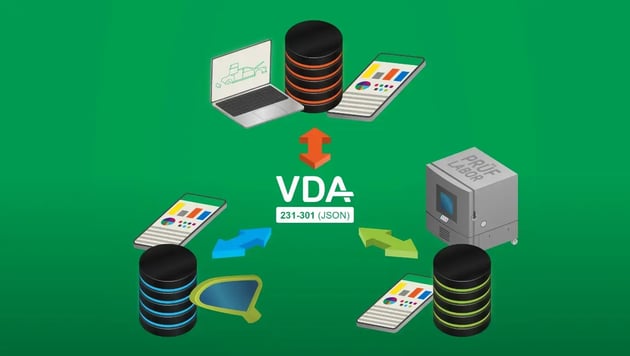
VDA 231-301 – Structured Exchange of Test Data
Through the VDA 231-301 recommendation, the VDA is advancing the harmonization of digital exchanges of testing and material data. The goal is to establish a generic, machine-readable data model for the structured description of:
- Testing requirements
- Testing conditions
- Result structures
- References to standards and specifications
The standard defines a common semantic foundation and a technical structure that allows for cross-system processing without interpretative ambiguities.
This creates the foundation for:
- Automated validation of test results
- Consistent integration into CAQ, PLM, or ERP systems
- Audit-proof documentation
- A comprehensive digital data chain from the testing system to the OEM
Thus, VDA 231-301 is a central component in transitioning from document-based quality assurance processes to data-driven, interoperable process chains.
Brain of Materials: Active Involvement and Operational Implementation
As a platform for structured material data exchange, Brain of Materials assists companies in efficiently, auditably, and conformally providing material and testing data throughout the entire supply chain.
Brain of Materials actively participates in VDA 231-301 and integrates its practical experience from OEM, Tier, and material manufacturer projects into the standardization process. Furthermore, we are committed to supporting additional industry-wide relevant standards to promote a seamless and interoperable data landscape.
Our platform enables direct utilization of VDA 231-301 data models and integration into existing system landscapes. This establishes the operational groundwork for smooth, digital data exchanges among all stakeholders in the value chain.
Additional Clarity through BusinessKeys and TestID
Within the framework of VDA 231-301, so-called BusinessKeys can be employed to enhance the existing data model with unique identifiers. Here, Brain of Materials utilizes the TestID (TID) as a supplementary identifier. The TestID aids in:
- Clearly referencing testing methods
- Eliminating ambiguities in customer-specific requirements
- Structuring the representation of variations in testing conditions
- Ensuring comparability between projects, suppliers, and OEMs
The combination of a standardized data model and unique identification significantly enhances automation potential and data quality.
Summary
The inception of VDA 231-301 marks an important milestone for the digitalization of materials quality assurance in the automotive industry. Standardized test data interfaces facilitate a continuous, valid, and automatable data chain across company and system boundaries.
Companies that take this step early will benefit from:
- Reduced process costs
- Accelerated approvals
- Increased data transparency
- Improved scalability
Brain of Materials not only supports the implementation of the standard but actively contributes to its further development, fostering a robust, interoperable, and future-proof material data infrastructure.
Curious?
Would you like to understand how VDA 231-301 can be specifically implemented in your existing system and process landscape, and what efficiency potentials can be realized through a structured, standardized data exchange?
In our complimentary webinar, we will demonstrate practical applications of how Brain of Materials can serve as an operational infrastructure for testing and material data. Together, we will analyze typical integration scenarios, automation potentials, and specific use cases along the supply chain.
Secure your appointment now and discuss your individual requirements directly with our experts.