How the TestID (TID) Enables Machine-Readable Digital Specifications for Test Requirements, Eliminates Interpretation in Materials Quality Assurance, and Why Brain of Materials Is the Implementation Platform of Choice for OEMs, Tier Suppliers, and Material Manufacturers
In materials quality assurance, ambiguous test requirements remain one of the most
persistent sources of delay, coordination overhead, and inconsistent results. The TestID
(TID), developed by Brain of Materials, resolves this by transforming every testing
requirement into a unique, machine-readable digital specification – one that any
stakeholder in the supply chain can interpret identically. This comprehensive guide
explains what a TestID is, how it creates true digital specifications from traditional test
requirements, how it integrates with VDA 231-301, and how organisations can implement
TestID-based workflows to unlock up to 45% efficiency gains in sampling, PPAP, and
release processes.
What Is the TestID? – Definition, Purpose, and Role in Digital Specifications
The TestID (TID) is a unique, machine-readable identifier that precisely defines an individual
testing requirement – including its methodology, parameterisation, conditions, and specification references. Developed and maintained by Brain of Materials and managed in the GlobalTestIDSystem, the TestID was created to solve one of the most persistent challenges in materials quality assurance: the ambiguity inherent in conventional test requirements and delivery specifications.
In traditional workflows, test requirements are communicated through standards, OEM
specifications, or internal guidelines. However, these documents frequently contain
formulations that leave room for interpretation. Different stakeholders – whether OEMs such as Volkswagen, BMW, or Mercedes, Tier 1/2 suppliers, material manufacturers, or accredited testing laboratories – may understand the same testing requirement in different ways. This interpretative leeway translates directly into coordination overhead, delayed approvals, and inconsistent test results across the entire automotive supply chain.
The TestID addresses this problem at its root. By encoding every relevant parameter of a test requirement into a single, unambiguous reference, the TestID transforms vague,
document-based testing specifications into precise digital specifications that can be
processed automatically across systems and organisational boundaries. Currently, a
mid-four-digit number of TestIDs already exists within the GlobalTestIDSystem, with new
identifiers being added on a weekly basis. In this way, the TestID serves as the semantic
anchor for a fully digitised testing and material data landscape.
Why Digital Specifications for Test Requirements Matter – Strategic and Operational Impact
The digitalisation of materials quality assurance – particularly in the automotive and plastics
industries – depends fundamentally on the availability of structured, machine-readable data.
Yet a significant portion of testing workflows still operates on the basis of PDF data sheets,
proprietary Excel templates, email-based coordination, and manual interpretation of normative texts. Analogue systems and outdated workflows are holding back innovation in millions of product type approvals, costing OEMs and suppliers millions due to lost productivity and missed market opportunities.
For C-level and management decision-makers, the consequences are quantifiable:
pre-development and series-development timelines that stretch over 50 months until Start of Production (SOP) when they could be reduced to 25 months, and efficiency losses that
compound across every new material programme. For technical decision-makers – Quality
Assurance leads, Material Engineers, Lab Managers – the fragmented approach creates
substantial daily friction:
- Increased coordination efforts between OEMs, Tier suppliers, and testing laboratories
to clarify the exact scope and conditions of each test - Inconsistent interpretation of standard requirements, leading to divergent test results
and repeated testing cycles - Manual definition and communication of specific testing scopes, consuming resources
that could be allocated to higher-value engineering activities - Limited comparability of results across projects, suppliers, and time periods –
undermining historical trend analysis and benchmarking - Restricted automation capabilities in CAQ, PLM, and ERP systems due to the absence
of structured, machine-readable test data - Delays in sampling, PPAP (Production Part Approval Process), PPF (Production
Process and Product Release), and APQP (Advanced Product Quality Planning) that
directly impact time-to-market
A scalable, efficient, and audit-proof quality assurance process therefore requires digital
specifications that eliminate interpretative ambiguity. The TestID provides exactly this
foundation – a clear, standardised identification system for every testing requirement,
regardless of the underlying standard, OEM specification, or customer-specific
parameterisation.
How the TestID Is Structured – A Hierarchical, Machine-Readable Digital Specification
What distinguishes the TestID from a simple reference number is its hierarchical, semantically complete structure. A TestID is not merely a label attached to a test requirement – it is a fully structured digital specification that encodes the complete testing context in a format that any system can process.
A key engineering principle of the TestID is that components are reused across
TestIDs wherever possible. Identical specimen conditioning procedures, for example, are
referenced by the same underlying Procedure ID across multiple TestIDs – ensuring
consistency, reducing redundancy, and enabling systematic updates when a standard or
method evolves. TestIDs are exchanged in JSON format, which aligns seamlessly with modern data infrastructures and with the VDA 231-301 data model. Within Brain of Materials, TestIDs are additionally available in human-readable views, allowing engineers and quality managers to understand and validate the underlying digital specification without requiring JSON expertise.
From Ambiguous Test Requirements to Precise Digital Specifications: A Concrete Example
To illustrate the practical impact of the TestID, consider a common scenario in automotive
materials testing. A delivery specification might state: “Tensile test according to ISO 527 at
room temperature.” On the surface, this appears to be a clearly defined test requirement. In
practice, however, this formulation raises immediate questions:
- Which specimen geometry is to be used – Type 1A, Type 1B, or another variant?
- What strain rate applies – 1 mm/min, 5 mm/min, 50 mm/min?
- How long must the specimen be conditioned before testing, and at what humidity?
- What constitutes “room temperature” – 20°C, 23°C, or a defined range with tolerance?
- What are the acceptance criteria – minimum tensile strength, elongation at break,
modulus, or a combination?
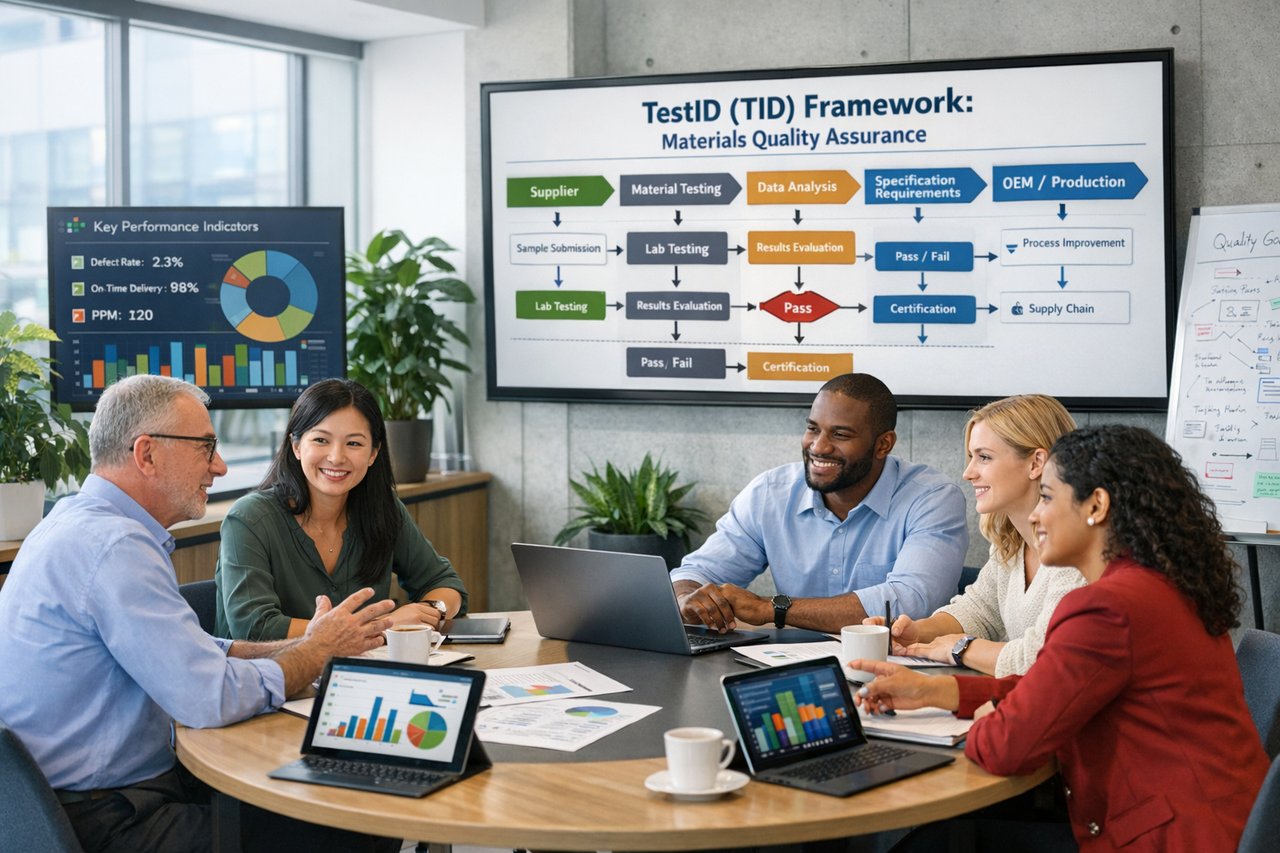
A corresponding TestID resolves every one of these parameters into a single, unambiguous,
machine-readable identifier. The commissioning party, the testing laboratory, and the
evaluating OEM all share an identical understanding of what is to be tested, under which
conditions, and according to which specification. No iterative clarification cycles. No
interpretation meetings. No costly re-testing because two parties worked from different
assumptions.
This precision is what distinguishes a true digital specification from a merely digitised
document. Scanning a PDF or converting an Excel table into a database entry creates a digital representation, but it does not resolve the underlying ambiguity. The TestID, by contrast, creates a semantically complete digital specification that supports automated validation, cross-system integration, and audit-proof documentation – the prerequisites for any scalable, data-driven quality assurance process.
See the TestID in Action: Book a free, non-binding webinar with our experts and
experience how your testing workflows can be digitised end-to-end.

The TestID Within the VDA 231-301 Framework
The value of the TestID is further amplified within the context of VDA 231-301 – the
recommendation published by the German Association of the Automotive Industry (VDA) for
the standardised, machine-readable exchange of material test results. VDA 231-301 defines a JSON-schema-based data model for structuring testing requirements, testing conditions, and result structures, and is publicly maintained via an open GitHub repository.
VDA 231-301 introduces the concept of BusinessKeys – unique identifiers that can enhance
the standardised data model with precise references. The TestID is designed to function as
exactly such a BusinessKey, and can be used within any VDA 231-301 file to bridge the gap
between the normative data model and operational testing practice.
By embedding TestIDs into the VDA 231-301 data model, organisations achieve:
- Unambiguous referencing of every testing method within a standardised, open data
exchange format - Automated validation of incoming test results against defined acceptance criteria
- Consistent integration of test data into downstream systems such as CAQ, PLM
(Product Lifecycle Management), and ERP platforms - Audit-proof documentation of the entire testing chain, from requirement definition
through to result evaluation, in line with IATF 16949 expectations - Cross-project and cross-supplier benchmarking on a consistent, comparable data basis
The combination of VDA 231-301’s standardised data structure and the TestID’s unique
identification creates a robust digital infrastructure for seamless, valid, and scalable test data exchange across the automotive supply chain and beyond – including aerospace, healthcare, packaging, textiles, and furniture industries.
Key Benefits of TestID-Based Digital Specifications for Test Requirements
Organisations that adopt the TestID for their testing workflows unlock measurable
improvements across both strategic KPIs and day-to-day operational metrics in materials
quality assurance.
Elimination of Ambiguity in Test Requirements
Every testing requirement receives a unique, machine-readable identifier that encodes
methodology, parameterisation, and conditions without interpretative leeway. This eliminates the coordination overhead that arises when OEMs, suppliers, and laboratories interpret the same specification differently – massively reducing engineering costs at laboratories, which no longer need follow-up questions about test scope.
Accelerated Sampling, PPAP, and Release Processes
When testing laboratories receive unambiguously defined test requirements through TestIDs, iterative clarification cycles are virtually eliminated. A complete test plan can be configured in under five minutes, and results are automatically mapped back to the corresponding TestIDs – reducing the overall testing cycle from weeks of manual coordination to a streamlined digital process measured in minutes. For OEMs, this translates to faster Volkswagen Produktfreigabe, BMW Produktfreigabe, Mercedes Produktfreigabe, and initial sample test report generation cycles.
Enhanced Data Quality and Cross-Supplier Comparability
Standardised, semantically clear digital specifications ensure that test results are consistently structured and directly comparable across projects, suppliers, and time periods. This enables meaningful cross-supplier benchmarking, historical trend analysis, and the construction of comprehensive requirement plans that consolidate past and current test data.
Increased Automation and Scalability
Machine-readable TestIDs enable automated processing of test data across systems and
organisational boundaries. Validation, integration into CAQ or PLM systems, and generation of comprehensive requirement plans can all be automated – making the testing process scalable even for organisations managing complex, multi-material, multi-OEM test programmes.
Reduced Process Costs and Measurable Efficiency Gains
By eliminating manual data transfers, redundant data collection, and iterative clarification
cycles, TestID-based workflows significantly reduce the administrative burden associated with materials quality assurance. Brain of Materials supports efficiency gains of up to 45% for suppliers and OEMs in the initial phase, and enables a reduction of pre-development and
series-development time from 50 to 25 months until SOP.
Audit-Proof Documentation and Compliance Readiness
A continuous digital data chain from test commissioning through to result evaluation satisfies regulatory and quality management requirements, including those aligned with IATF 16949 and ISO 9001. Every step is traceable, every test requirement is unambiguously documented, and every result is linked to its defining specification – essential for modern automotive compliance.
Who Benefits from Digital Specifications with the TestID?
Automotive OEMs
OEMs benefit from automated validation of incoming test results against defined acceptance
criteria, reducing manual review effort and accelerating approval timelines. Digital
specifications through TestIDs provide a consistent, audit-proof data basis for regulatory
compliance and internal quality management – whether the requirements originate from an
established OEM partnership or are uploaded and digitised via the Brain of Materials platform for use within the TestID ecosystem.
Tier 1 and Tier 2 Suppliers
Suppliers benefit from drastically reduced coordination overhead when communicating test
results to multiple OEMs. Instead of maintaining separate, customer-specific reporting formats, they adopt a single standardised digital specification interface powered by TestIDs that satisfies the requirements of all downstream partners simultaneously.
Material Manufacturers and Compounders
Material manufacturers face particularly complex testing programmes, often involving dozens of individual tests per material grade across multiple OEM specifications. TestID-based digital specifications enable these organisations to structure their test data once and exchange it consistently with all customers – and, through network effects within Brain of Materials, their sales teams can even receive notifications when Tier-1 engineers show interest in suitable products.
Testing Laboratories and Service Providers
Accredited testing laboratories benefit from receiving unambiguously defined testing
requirements via TestIDs and returning results in a structured format that integrates directly into their clients’ systems. This eliminates iterative clarification cycles and enables laboratories to operate more efficiently at scale, massively reducing engineering costs per request.
Brain of Materials: The Implementation Platform for TestID-Based Digital Specifications
Brain of Materials is a B2B SaaS platform for structured material data exchange, founded in
2019 and headquartered in Mönchengladbach, Germany. The platform provides a
comprehensive suite of functions for every company involved in the supply chain, from OEMs and Tier 1/2 suppliers to material manufacturers and accredited testing laboratories. As the developer and maintainer of the TestID and the GlobalTestIDSystem, Brain of Materials offers a uniquely integrated solution for organisations seeking to digitalise their testing workflows.
Direct Utilisation of TestIDs and VDA 231-301 Data Models
The Brain of Materials platform enables direct configuration of test plans using TestIDs,
exchange of test results in VDA 231-301-compliant formats, and automated validation of
incoming data against defined specifications – all within a single, centralised environment that eliminates media discontinuities. The platform is designed to support existing processes rather than forcing entirely new workflows on its users.
Integrated Laboratory Commissioning via 50+ Accredited Laboratories
Brain of Materials provides direct access to a network of over 50 accredited testing laboratories through a single platform. Once a test plan has been configured using TestIDs, multiple laboratories can submit offers for comparison, and the customer can accept the most suitable one – with no fees charged to the participating laboratories. Test results are automatically fed back into the platform, mapped to the corresponding TestIDs, and immediately available for evaluation, benchmarking, and downstream system integration.
AI-Assisted Legacy Data Conversion and Retrospective TestID Assignment
A significant practical challenge in adopting digital specifications lies in the conversion of
existing legacy data – historical test results stored in PDF data sheets, Excel files, or
proprietary formats. Brain of Materials addresses this through a hybrid methodology that
combines AI-based text and structural analysis, algorithmic extraction engines, rule-based
mapping logic, and continuous domain-expert validation. This conservative yet effective use of AI at process bottlenecks enables organisations to upload existing data sheets, automatically detect testing requirements, and receive suggestions for appropriate TestID assignments – transforming legacy document repositories into a consistent, interoperable data source without abandoning institutional knowledge.
TISAX-Certified, ISO 9001-Compliant, EU-Hosted Data Security
Brain of Materials is TISAX-certified and ISO 9001-compliant, with all data hosted exclusively
on servers in the European Union – currently in Germany. This ensures that all material and
testing data is handled in accordance with the stringent security requirements of the automotive industry, and provides the trusted foundation that enterprise customers require.
How to Get Started: A Practical Roadmap for Implementing Digital Specifications with the TestID
Organisations considering the adoption of TestID-based digital specifications can follow a
structured, low-risk implementation approach:
- Assess the Current Data Landscape: Inventory existing test data formats, identify
pain points in current exchange processes, and evaluate the volume of legacy data
requiring conversion to digital specifications. - Define Integration Requirements: Determine which downstream systems – CAQ,
PLM, ERP – should receive structured test data, and map the required data flows for
your test requirements. - Implement the TestID Framework: Assign unique TestIDs to all testing requirements
to ensure unambiguous identification and machine-readable referencing across the
supply chain. - Convert Legacy Data: Use a hybrid methodology combining automated AI-based
extraction with targeted expert validation to transform historical test data into
standardised digital specifications – cost-effectively and reliably. - Integrate with VDA 231-301: Connect the standardised data interface to existing
systems, establish automated validation rules, and verify end-to-end data flow from test commissioning through to result evaluation. - Scale Across the Supply Chain: Extend the standardised digital specification
interface to suppliers, laboratories, and OEM partners – establishing a fully digital,
interoperable data chain that supports APQP, PPF, and PPAP processes at scale.
Frequently Asked Questions About TestID, Digital Specifications, and Test Requirements
What is a TestID (TID)?
A TestID is a unique, machine-readable identifier developed by Brain of Materials that precisely defines a testing requirement, including its methodology, parameterisation, conditions, and specification references. Managed in the GlobalTestIDSystem and exchanged in JSON format, it eliminates ambiguity in test requirements and enables automated processing of test data across the supply chain.
What is a digital specification in materials quality assurance?
A digital specification is a machine-readable, semantically complete description of a testing
requirement that can be processed automatically across systems and organisational
boundaries. Unlike digitised documents (such as scanned PDFs or Excel tables), a true digital
specification resolves all ambiguity and encodes every relevant parameter in a structured
format – precisely what the TestID delivers.
How does the TestID relate to VDA 231-301?
The VDA 231-301 introduces the BusinessKey concept, and the TestID is designed to function as exactly such a BusinessKey. It can be used within any VDA 231-301 file to provide unambiguous references that bridge normative text and operational testing practice.
Can the TestID be used outside the automotive industry?
Yes. While the TestID was developed within the automotive context, its concept is
industry-agnostic and applicable wherever structured, quality-assured exchange of material
test data is required – including aerospace, medical devices, packaging, textiles, furniture, and general industrial manufacturing.
What is the difference between a test requirement and a digital specification?
A test requirement describes what needs to be tested, often in textual or normative form. A
digital specification takes this further by encoding the requirement in a machine-readable,
parameterised format (such as a TestID) that eliminates interpretative leeway and enables
automated validation and processing across any compatible system.
How does Brain of Materials support retrospective TestID assignment for legacy data?
Brain of Materials uses a hybrid methodology combining AI-based text and structural analysis, algorithmic extraction engines, rule-based mapping logic, and continuous domain-specific validation through expert feedback loops. This approach enables organisations to transform existing data sheets and legacy documents into structured, TestID-referenced digital specifications reliably and cost-effectively.
What standards does the TestID support?
The TestID system is standard-agnostic and can reference any testing standard, including ISO, DIN, ASTM, VDA, SEP, EN, and OEM-specific delivery specifications. Within VDA 231-301,
dedicated sub-schemas exist for specific standards such as VDA 275, VDA 278, VDA 270,
SEP 1240, and EN 10204.
How quickly can a test plan be configured using TestIDs?
With Brain of Materials, a complete test plan can be configured in under five minutes using
TestIDs. Laboratories can be commissioned directly from within the platform via the 50+
accredited laboratory network, and results are automatically fed back and mapped to the
corresponding TestIDs – with no manual re-entry required.
Summary: The TestID as the Foundation of Digital Materials Quality Assurance
The TestID represents a decisive step forward in the digitalisation of test requirements and
the creation of true digital specifications for materials quality assurance. By providing a
unique, machine-readable, hierarchically structured identifier for every testing requirement, the TestID eliminates the ambiguity, coordination overhead, and media discontinuities that have long characterised traditional, document-based quality assurance processes across the
automotive supply chain.
In combination with standardised data exchange frameworks such as VDA 231-301 – where
the TestID functions as a BusinessKey – organisations gain a robust foundation for automated validation, cross-system integration with CAQ/PLM/ERP landscapes, and audit-proof documentation aligned with IATF 16949 expectations. Brain of Materials, as the developer of the TestID system, active contributor to VDA 231-301, and provider of a TISAX-certified SaaS platform, delivers the operational infrastructure to implement these digital specifications across the entire supply chain.
Organisations that adopt TestID-based digital specifications early benefit from up to 45%
efficiency gains in the initial phase, a reduction of pre-development and series-development
time from 50 to 25 months until SOP, accelerated Volkswagen / BMW / Mercedes approvals,
enhanced data quality, increased scalability, and a future-proof infrastructure for materials
quality assurance in an increasingly digital and interconnected supply chain.
Ready to Transform Your Test Requirements Into Digital Specifications?
Would you like to understand how TestID-based digital specifications can be concretely
implemented in your existing system and process landscape – and what efficiency potentials
can be realised through structured, standardised data exchange of test requirements across
your supply chain?
In our complimentary webinar, we will demonstrate practical applications of how Brain of
Materials can serve as an operational infrastructure for testing and material data. Together, we will analyse typical PLM integration scenarios, automation potentials, and specific use cases along the supply chain.
Secure your appointment now and discuss your individual requirements directly with our experts.